Blepharoplasty in Newcastle
As the years pass, the skin of the upper eyelids can begin to droop and gather into heavy folds. For some people this is simply a change in appearance they would rather not see. For others, heavy upper lids start to rest on the lashes and crowd the edges of their vision. Upper eyelid blepharoplasty, sometimes known as eyelid lift surgery, is the procedure that addresses this, and it is one of the operations I perform most often.
My name is Mr Chris Matthews. I am a consultant ophthalmologist and oculoplastic surgeon, and I look after patients privately here in the North East, at Newmedica in Newcastle. Oculoplastic surgery, the surgery of the eyelids and the structures around the eye, is my specialist field, and I bring to it the same care and precision I use in my NHS practice every week.
What blepharoplasty actually does
Upper eyelid blepharoplasty is the careful removal of excess skin, and sometimes a small amount of fat, from the upper eyelid. Over time the skin above the eye loses its elasticity and begins to fold downwards, gathering into a hood that can make the eyes look tired and, in more pronounced cases, can genuinely interfere with the upper field of vision. Removing the excess restores a clearer, more open eyelid and, where vision was affected, a clearer view.
If you would like to understand the procedure in more depth before reading on, I have written a fuller patient guide to blepharoplasty, as well as a guide to hooded eyes, on my education website, Eyes Explained.
Is your eyelid heavy, or is it actually drooping?
This is an important distinction, and it is one of the first things I check at a consultation. Heavy, hooding skin is a blepharoplasty problem. A drooping lid where the eyelid edge itself sits low, often because the small muscle that lifts the lid has weakened, is a different condition called ptosis, and it needs a different operation. The two can look similar in the mirror but they are corrected in different ways, and sometimes both are present together.
There is a third possibility that is easy to miss. Sometimes it is the eyebrow that has descended over the years, and a low brow pushes the skin downwards so that the upper lids look heavy when the eyelid itself is actually fine. In that situation lifting the brow is part of the answer, and operating on the eyelid alone rarely gives the result a patient is hoping for. Where the brow needs attention, I can raise it with a direct brow lift, or with an internal browpexy carried out through the same eyelid incision at the same time as your blepharoplasty, so that the lid and the brow are corrected together in a single procedure. Which approach suits you depends on your brow, your skin, and what you want to achieve, and I will talk it through with you at the consultation.
You can read more about the difference between blepharoplasty and ptosis repair if you are unsure which applies to you. Part of my job at the first appointment is to tell you exactly which it is.
Cosmetic or functional
Some people come to me because they dislike how tired or aged their eyes have begun to look. Others come because their vision is being affected. Both are entirely valid reasons to consider surgery, and I treat both with the same seriousness.
Where heavy upper lids are genuinely obstructing vision, upper eyelid surgery is sometimes funded by the NHS, but only in specific circumstances and where strict local criteria are met. Surgery undertaken purely to improve appearance is not funded by the NHS, and most people who want it choose to have it done privately. I am happy to talk you through honestly which category you are likely to fall into. I have written more about cosmetic versus functional eyelid surgery if it would help to read it in advance.
What the procedure involves
Upper eyelid blepharoplasty is carried out as a day case under local anaesthetic, which means you are awake but the eyelids are completely numb and you feel no pain. You will be able to go home the same day. The operation itself usually takes somewhere between forty-five minutes and an hour, depending on whether one or both eyes are being treated.
The incision is placed within the natural crease of the upper lid, so that once it has healed the scar is hidden in the fold and is very difficult to see.
Recovery, honestly
I think it is only fair to tell you what to expect rather than to gloss over it. There will be some bruising and swelling around the eyes in the first week or two, and this is entirely normal. Most people feel comfortable enough to be out and about within a few days, though they may prefer to wait until the bruising has faded before returning to work or social occasions. With upper eyelid surgery, the fine stitches used in the skin drop out on their own within a few weeks.
The eyelids continue to settle gently over the following weeks, and the final, refined result becomes clear over a month or two. The results of upper eyelid blepharoplasty are long lasting, often for many years.
What results can I realistically expect?
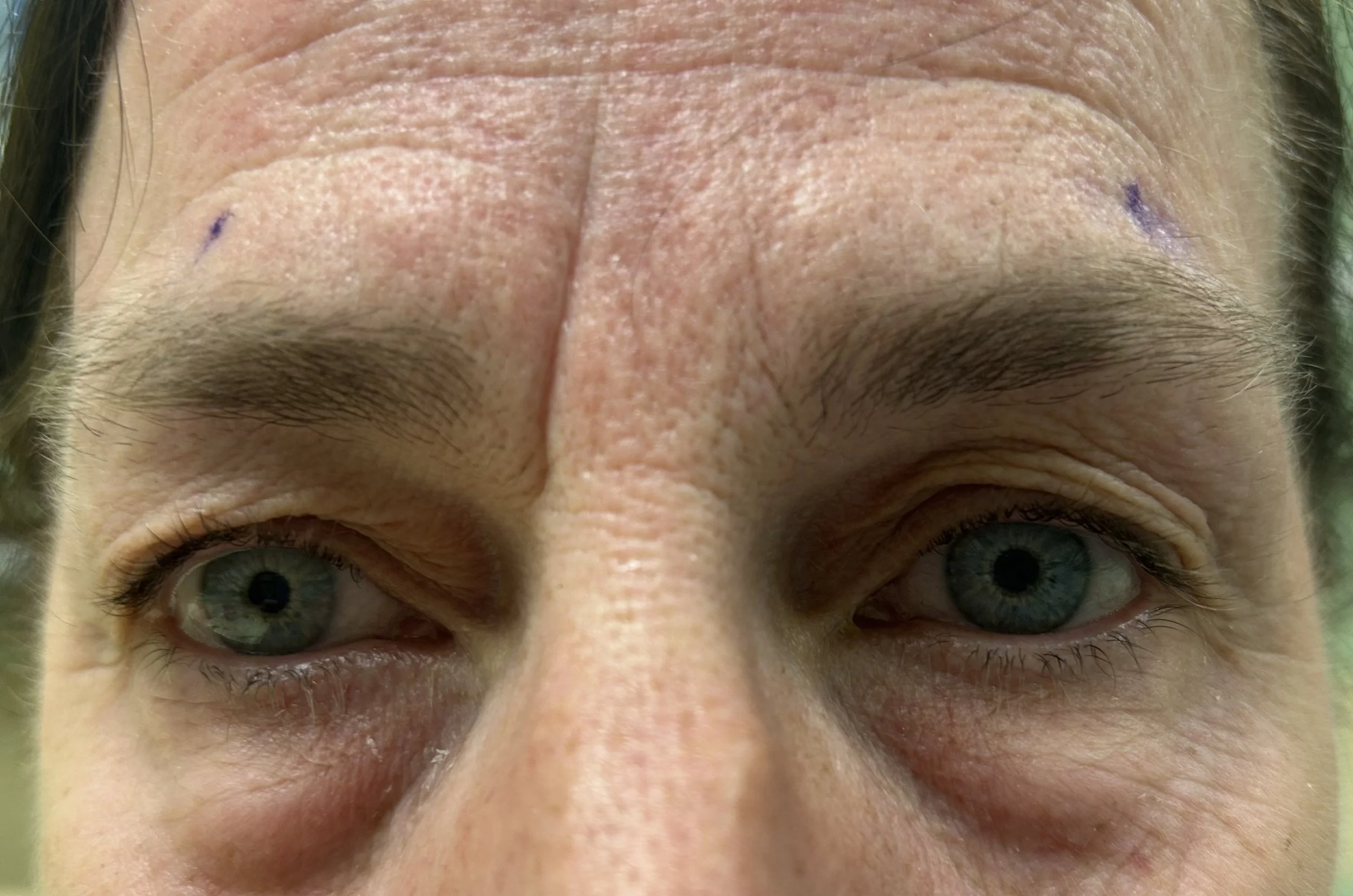
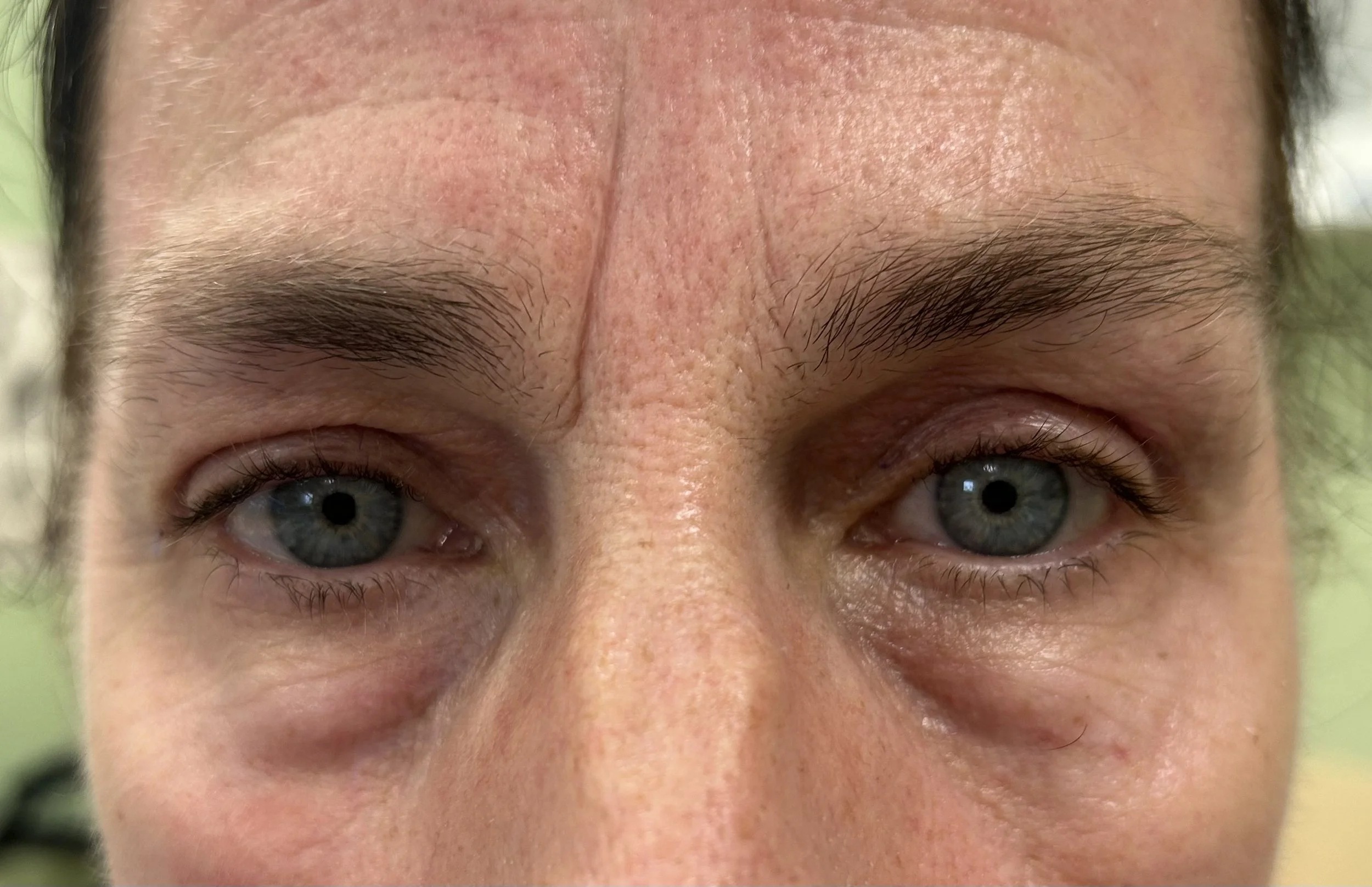
Below are some examples of upper eyelid blepharoplasty procedures I have performed. The patients shown have kindly given their consent for their photographs to be shared on this website. Individual results will vary, but these cases demonstrate the typical improvements that can be achieved with surgery.
51-year-old woman
This patient was troubled by heavy, irritable upper eyelids and was increasingly aware of her eyelashes resting in her field of vision. Following bilateral upper eyelid blepharoplasty, she achieved a more open appearance with relief of her symptoms.
Pre-op
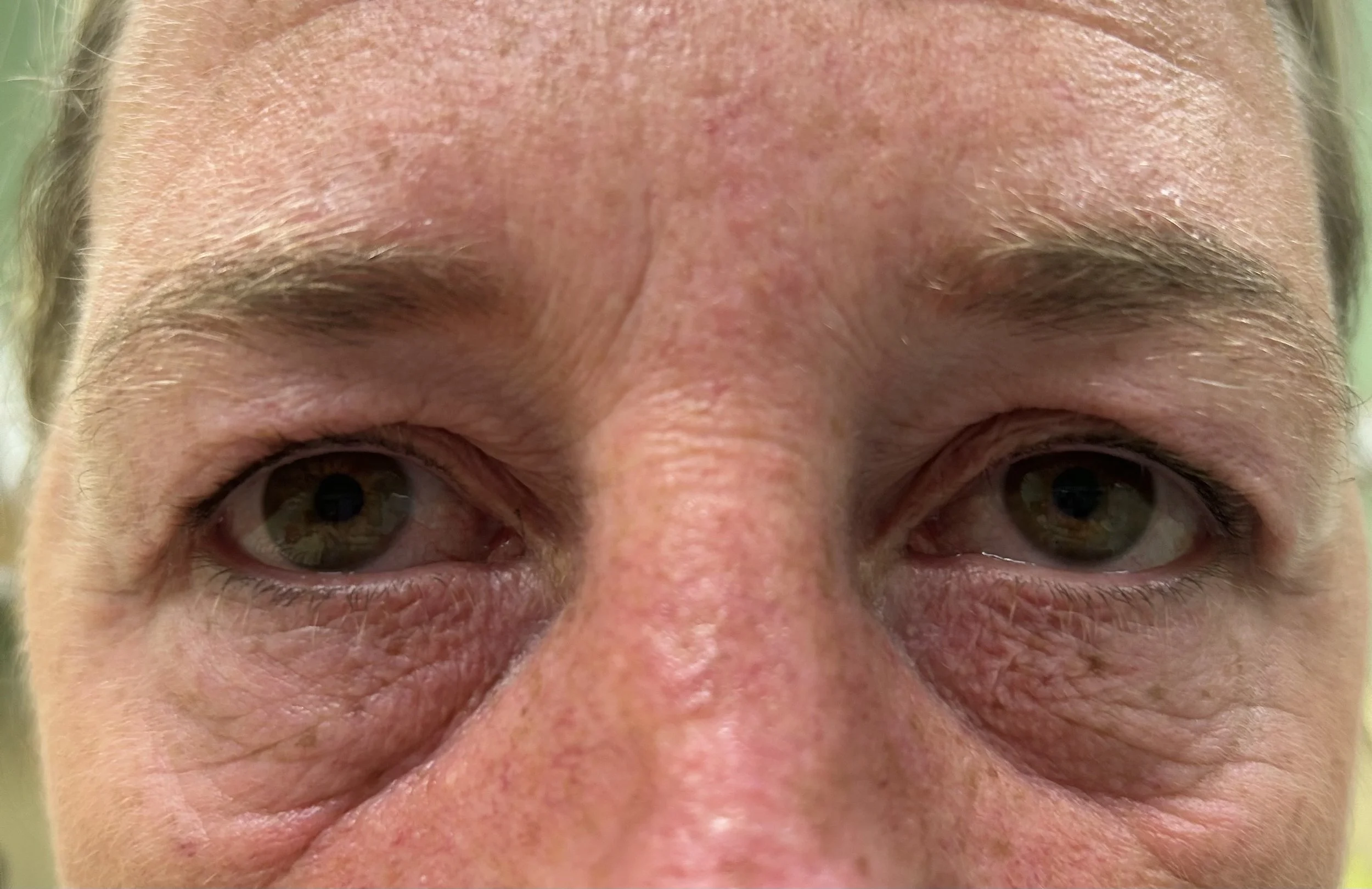
2 weeks post op
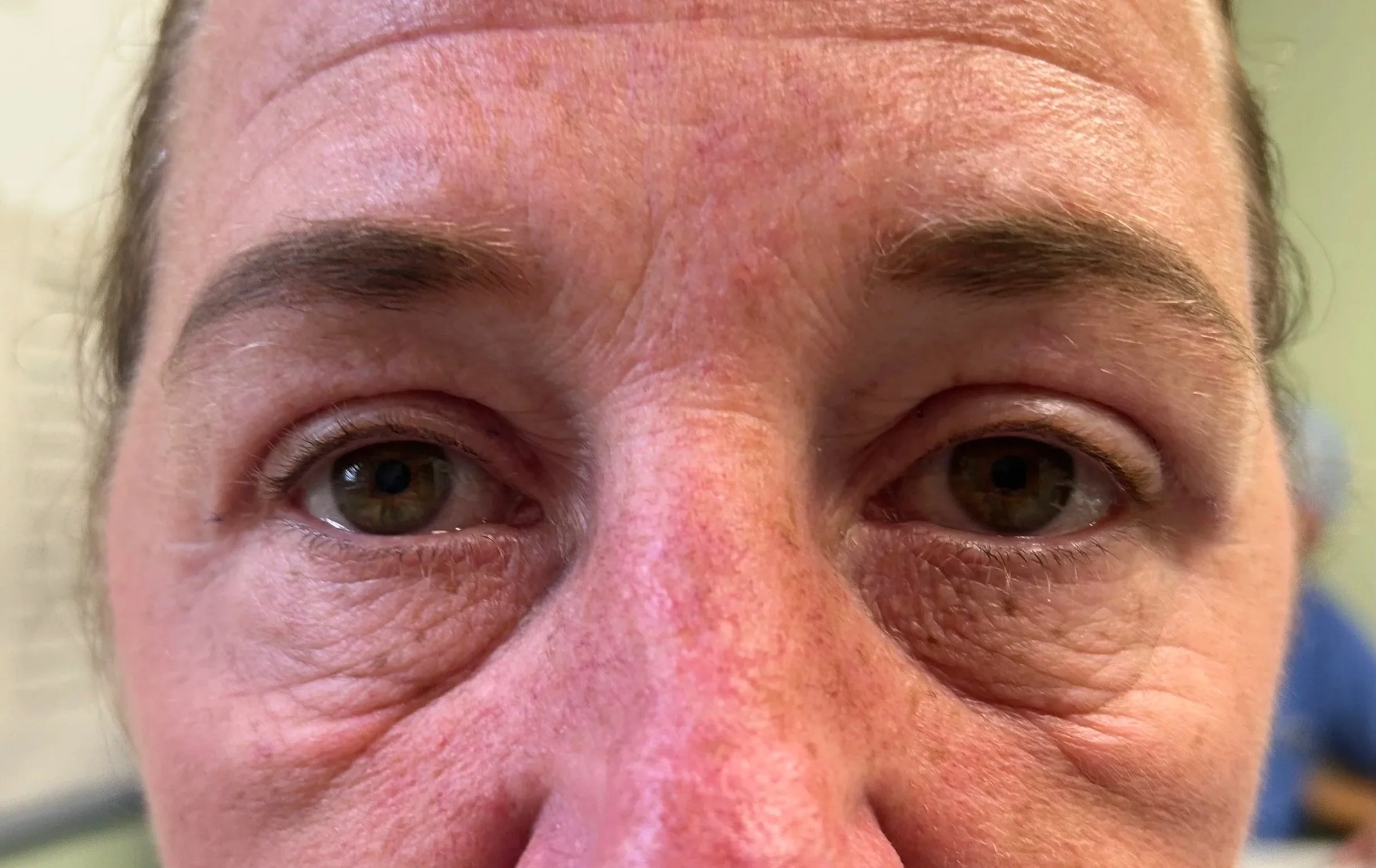
54-year-old woman
This patient found it difficult to keep her eyes open due to heavy skin. As well as this she could see the skin in her peripheral vision as she looked to the sides.
Pre-op
3 weeks post op
Why it matters that an oculoplastic surgeon does this
The eyelids are delicate and they have a job to do. They protect the eye, they spread the tear film with every blink, and they must close fully to keep the surface of the eye healthy. Remove a little too much skin and the eye may struggle to close properly, which is far more troublesome than the problem you started with. An oculoplastic surgeon is an eye surgeon first, trained in both the function and the appearance of the eyelid, and that combination is exactly what this surgery calls for.
Like any operation, blepharoplasty carries some risks, including bruising, swelling, temporary dryness of the eye, and minor differences between the two sides as they heal. Serious complications are rare. I will go through all of this with you properly before you decide anything, because consent should mean a real understanding, not a signature on a form.
I see and treat my private patients at Newmedica in Newcastle, and my fees follow Newmedica's standard self-pay price list, which you can view in full here: (https://www.newmedica.co.uk/private-patients/private-eye-treatment-prices/). If the procedure you need is not listed, the price is calculated for your individual case and a clear quote is provided before you decide anything.
These prices include the use of the clinic, the materials needed, and your aftercare.
Fees
Seeing me in Newcastle
I consult and operate privately at Newmedica in Newcastle, serving patients from across Newcastle, Durham, Northumberland, and the wider North East. You do not need a GP referral to see me privately. You are welcome to book a consultation directly, and we will start with an unhurried conversation about what is troubling you, an examination, and a clear, honest explanation of your options. If surgery is right for you, I will tell you. If it is not, I will tell you that too.
To arrange a consultation, please get in touch here:
-
My fees follow Newmedica's standard self-pay price list, which you can view here: Newmedica private eye treatment prices. If a procedure is not listed, the price is calculated for your individual case and a clear quote is provided. These prices include your aftercare.
-
Blepharoplasty surgery is carried out under local anaesthetic, so you are awake but the eyelids are fully numbed and you feel no pain. You go home the same day.
-
The incision is hidden in the natural crease of the upper lid and becomes very difficult to see once healed, settling into the fold of the eyelid.
-
Expect some bruising and swelling for one to two weeks. Most people are comfortable within a few days, and many choose to wait until the bruising settles before returning to work. The final result refines over a month or two.
-
The results of upper eyelid blepharoplasty are long lasting, frequently for many years. The skin continues to age gently over time, but the excess that has been removed does not simply grow back.
-
Upper eyelid surgery is occasionally funded by the NHS where heavy lids are genuinely obstructing vision and strict local criteria are met. Surgery for appearance alone is not NHS funded. I will tell you honestly which is likely to apply to you.
-
No. You can book a private consultation with me directly, without a GP referral.
-
These are two different conditions that can look alike. Loose, hooding skin is treated with blepharoplasty; a low-sitting lid edge is ptosis and is treated differently. Part of your consultation is establishing exactly which you have.